
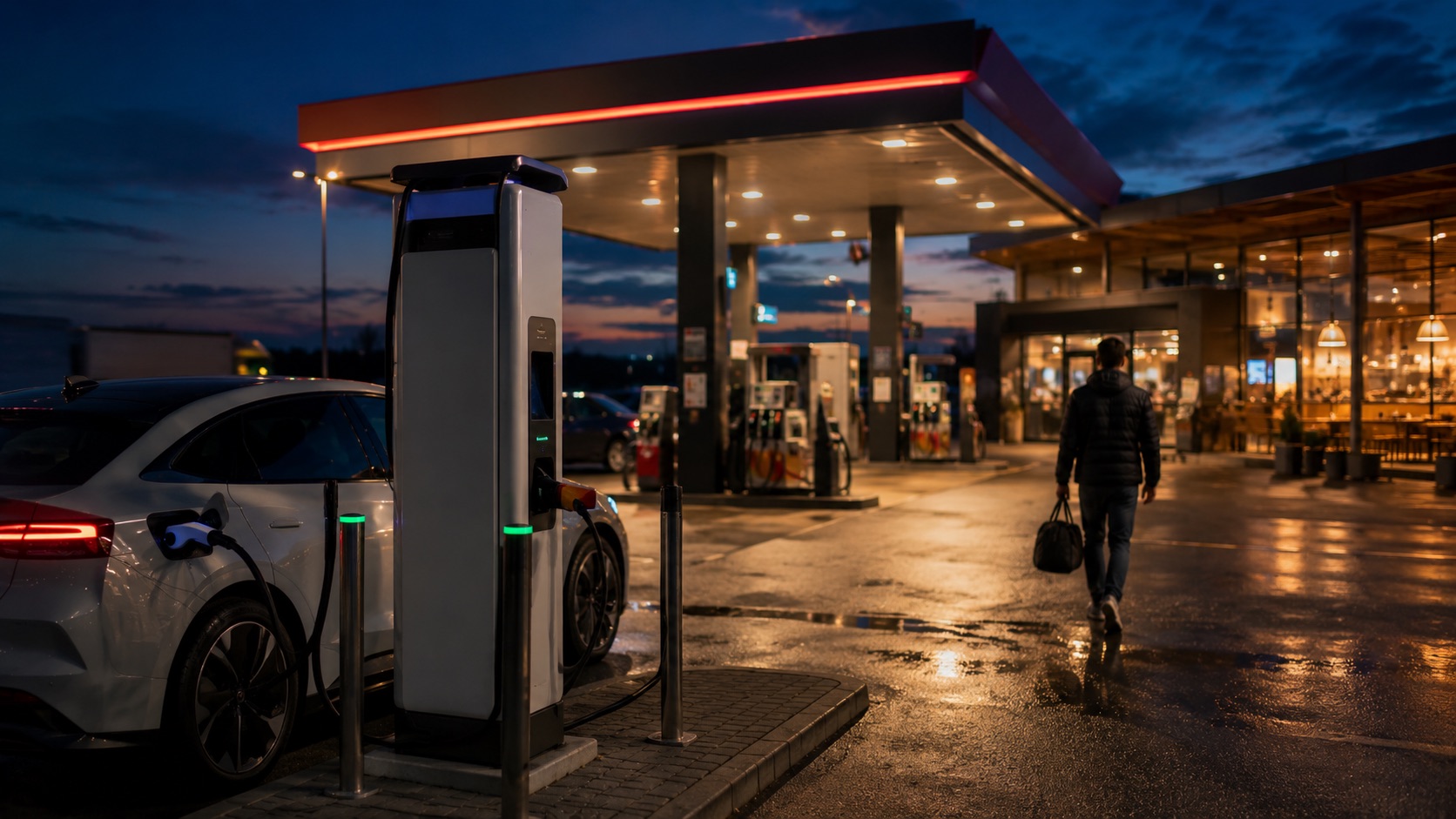
For decades, the service station was a simple place. You stopped, refueled, and drove on. Today, it is a hub of transformation. In addition to diesel and petrol, rapid charging points are increasingly part of the landscape. With them, the way people stop on the highway and how long they stay is changing.
Two Drive Systems Under One Roof
Internal combustion and electric vehicles will coexist for the foreseeable future, and they have different needs. Those who refuel are back on the road in a few minutes. Those who charge plan a longer stop, often twenty minutes or more. For a highway location, this means a dual task. Both groups must, of course, be served without one hindering the other. This applies to access roads and the number of charging points, as well as where charging takes place and how well the routes to them are signposted.
The Stay Becomes the Focus
A charging process rarely takes just a moment. Travelers spend this time not at their vehicle, but in the restaurant, in the shop, or taking a break in the fresh air. Thus, the stay itself gains importance. The rest stop is transforming from a mere transit point to a place where one consciously lingers. For us, this is less a challenge than an opportunity. Those who are waiting anyway are open to a good offer, a comfortable place, and a service that makes the time pleasant.
“Those who charge stay longer. And those who stay longer expect a place where waiting is worthwhile.”
Ready for the Coming Years
The transformation of mobility is also decided on the highway. Those who invest today in charging infrastructure, quality of stay, and service are prepared for the coming years. We therefore do not see the energy transition as a break with the past, but as a further development of a place that has always reliably served travelers. In the future, with diesel, petrol, and electricity, depending on how our guests are traveling.